|
|
Where the line sits between you and AI, and a prompt to find it in your
own week.
|
|
|
|
|
044: Give Away The Work...
|
|
|
|
|
Quick question before we start. When did you last send something AI
wrote for you without reading it first? (Be honest. Nobody is
watching.) My drafts folder is full of emails my AI agents wrote
for me: follow-ups, replies, proposals for clients.
|
|
|
|
|
Every one of them waits there until I have read it, changed what
needs changing, and pressed send myself.
(Yes, this newsletter started as a draft too. My agent was writing
it while I was speaking at a conference in Spain. You are reading
the version after I got my hands on it.)
I have close to 30 AI agents by now. They collect my receipts, look
after my website and help with my proposals. So they do a lot of
the work.
Pressing send stays with me. So does deciding what I promise a
client, or what I say on a stage.
That is the whole idea behind my keynotes this autumn. Give away
the work. Never the judgment.
Time to read: 4 minutes
In this edition:
1. Leadership When AI Does the Work
2. Try This: Find Your Line With AI
3. One Last Thing: My Autumn Keynote Series
|
|
|
|
Leadership When AI Does the Work
|
|
|
|
|
Last week the World Economic Forum published a piece
that could have been my speaker notes.
The point: as AI does more of the analysis and the doing,
leadership moves to the decisions you cannot hand over.
The authors are specific about what those are: defining the
problem, asking better questions, and spotting a challenge before
it turns into a crisis.
That matches what I see every day with my own agents. They work
through whatever I give them, fast and well. Choosing what to give
them is my part.
It also gives two questions no system can settle for you: who has
the responsibility, and whose interests are missing.
I would print those two and stick them next to the screen.
If you have seen my TEDx talk,
some of this will sound familiar. I said it on that stage with the
red carpet last autumn, and several times ever since: AI
cannot take responsibility.
And near the end: let AI handle the rest. The sorting, the
reminders, all that stuff that eats up your day.
This autumn I go one step further: what exactly you give to AI, and
what you keep.
|
|
|
|
Try This: Find Your Line With AI
|
|
|
|
|
So how do you know what to do yourself, what AI should do, and
where a mix of both works best?
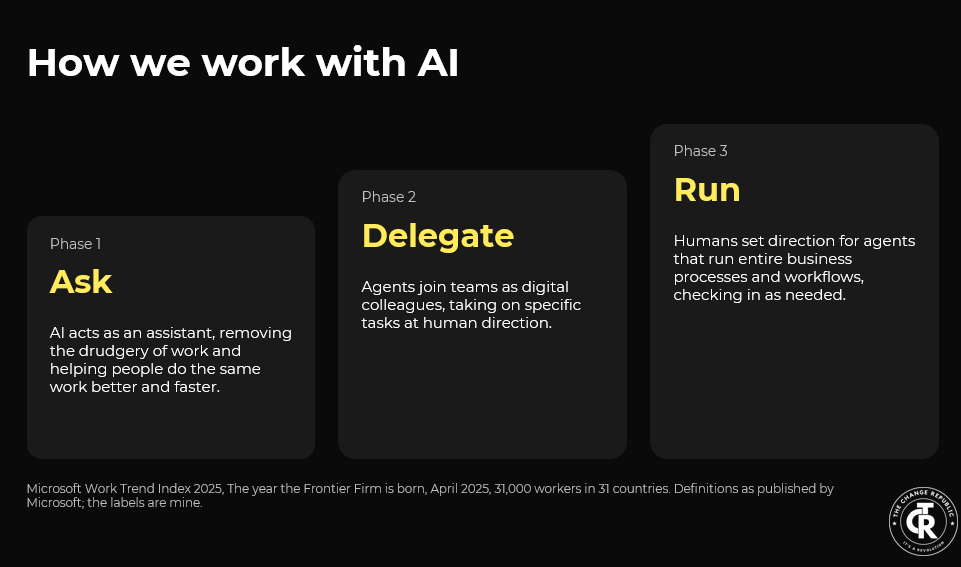
I like to start with a simple picture. Microsoft's Work Trend Index
2025 describes three phases of working with AI. The short labels
are mine.
|
|
|
|
|
Ask. AI is your assistant. It takes away the boring / time
consuming / precision tasks off your plate and helps you do the
same work better and faster.
Delegate. Agents join the team as digital colleagues and take on
specific tasks or small workflows, at your direction. You do not do
it once only, maybe you keep on delegating over and over again.
Run. You set the direction. Agents run whole processes, and you
check in when needed.
Where am I personally? Honestly, in all three, depending on the
task.
My receipts run on their own.
My proposals are mostly in Delegate. It starts with me: I put my
thoughts down first as a voice memo. Then an agent turns the memo,
the transcripts, the researches into a first draft, and we finalise
it together.
From ask to run, the speed is increasing and AI is getting more and
more autonomous. The further right a task moves, the less of each
step you see. The line is getting thin, can you still take
responsibility? So I suggest, draw the line first.
Which brings me to the prompt.
Maybe last time you did not get to do this prompt with me. Then do
it now. It is the first step to see where the line sits between you
and AI.
You need ten minutes and the AI tool that knows your work best:
ChatGPT, Claude, Copilot or Gemini. Pick the strongest model it
offers (right now that is Astra, Fable 5.1 or similar).
|
|
|
|
|
Start of prompt
Based on what you know about my role, responsibilities and
current way of working:
Step 1. Map the typical flow of my work. What are my inputs,
what outputs do I expect, and who makes the significant
decisions, you as the AI, or me.
Step 2. I do not want to hand over tasks that require my
human judgement. Highlight the tasks that do not require
uniquely human judgement. Be precise.
Step 3. Then recommend:
- which tasks should remain fully human
- which could be delegated to AI
- which could become part of a shared AI-supported workflow
Step 4. Prioritise by impact and feasibility.
Do not talk too much. Be concise and to the point.
End of prompt
|
|
|
|
|
|
When the answer comes back, go straight to the first list. The
tasks that should remain fully human.
Do you agree with it?
The answer is only as good as what your AI tool knows about you.
And it is worth running this prompt again from time to time, as
your work changes.
(And if the answer sounds vague, ask it to be specific: use my real
tasks. It listens.)
|
|
|
|
One Last Thing: My Autumn Keynote Series
|
|
|
|
|
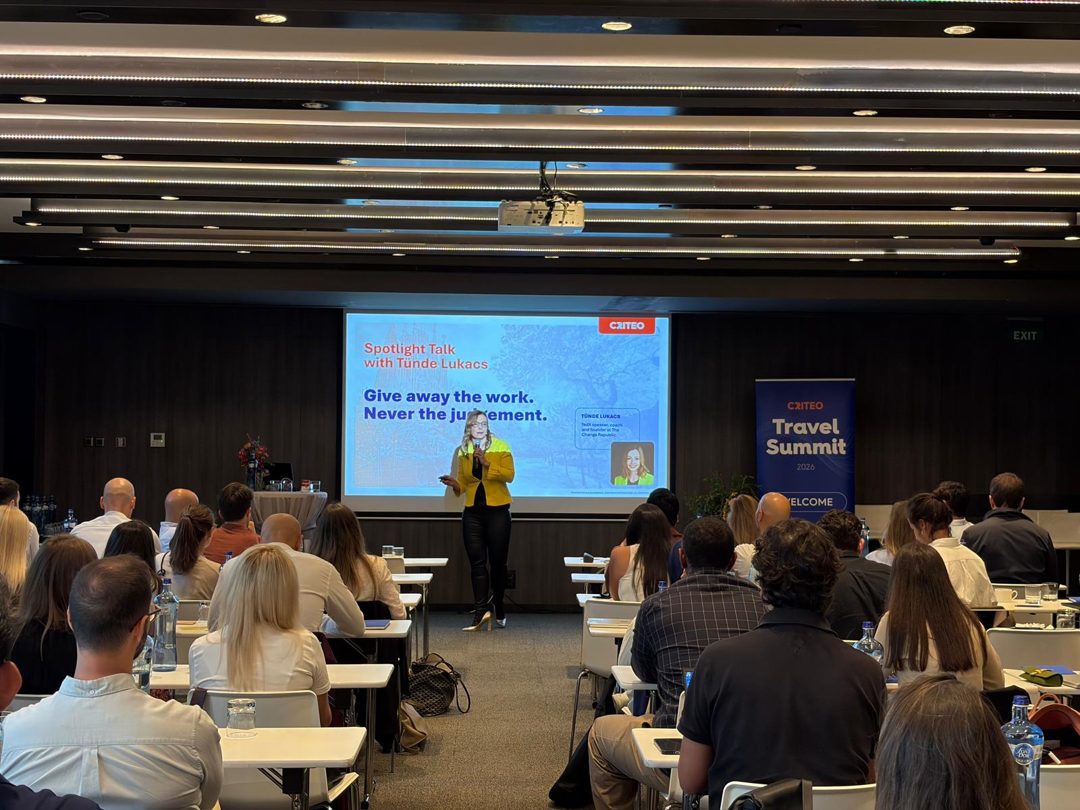
Give away the work. Never the judgment.
That is the title of my autumn keynote series, and I am really
happy to take it on the road.
The first stop was Barcelona, at the Criteo Travel Summit, for the
top marketing and growth executives in the travel industry.
More than ten organisations follow this autumn, as a keynote and as
a workshop.
If your leadership team, your offsite or your conference could use
it, everything is on my speaker page. Or just hit reply, that works
too.
|
|
|
|
|
That is it from me for this time.
What is on your fully human list? Hit reply and tell me, I read
every answer.
|
|
|
|
|
P.S. If you are near Zürich on Saturday 28 November,
TEDxHWZ is
back, with the theme Beneath the Surface. Last year the tickets
were gone a month early.
|
|
|
|
|
How can we work together?
|
|
|
|
|
Did you miss our last newsletters?
Inboxes can get a little crazy, right? Just in case you missed
them, here are the links to
our previous newsletters:
|
|
|
|
The Change Republic
Rötibodenstrasse 34, Wädenswil
Switzerland
|
|
You received this email because you signed up on our website
or made a purchase from us.
|
|
|
|
|
|

|
|
|