|
Time to read: 6 minutes
In this newsletter, you will find:
1. AI Workers Made Simple
2. The Coach I Built on Three Dog Walks
3. One Last Thing: The Real Bridge
AI Workers Made Simple
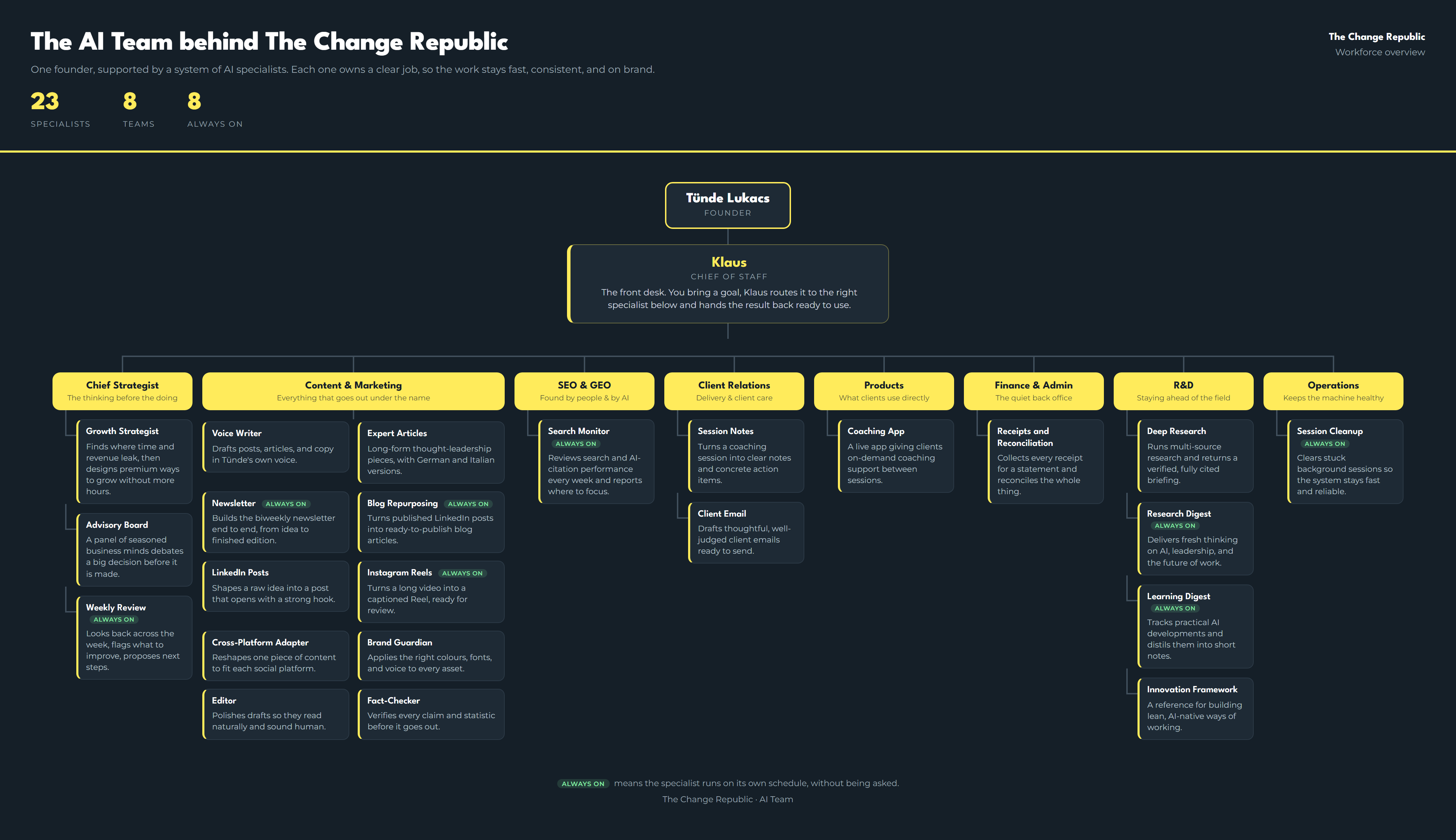
Tap or click the chart to open it full size.
It did not start with a plan. The first one was the voice worker. I
was tired of explaining how I want my emails, social media posts or
newsletters to sound, so one evening I wrote down how I feel it and
had the AI analyse my past emails, posts and newsletters. The
result was a 5+ page document summing up all the nuances and since
then I did not have to explain again.
Then I noticed the next task. And the one after. That is the honest
pattern. Nobody builds a team. You hand over one job, it works, and
the second one suddenly looks obvious.
Building one is far less technical than it sounds. I have never
written code. I write instructions in plain English, the way you
would brief a new assistant on their first morning. Here is how I
write. Here is what good looks like. Here is what I never want you
to do. Once the instructions exist, the worker runs the same
careful way every time, and never gets bored of it.
Now the part about you.
You already use AI. And if you look honestly at how, you will find
the same tasks coming back. The meeting follow-up. The summary of
the long document. The email that has to sound better than you have
time for. You are already running AI workers. You are just
re-hiring them from scratch every time, in a new chat, with new
instructions, and the quality depends on your mood that day.
And I can see the problem, almost nobody has an overview. Ask
yourself, what have I actually been asking AI to do these past two
months? The answer sits scattered across dozens of chats. So the
repeating work never gets named. And what never gets named never
gets handed over.
I wrote a prompt that does the naming for you. Choose the smartest
model on the AI tool you use most, ChatGPT (5.5), Claude (Opus 4.8
or Fable 5) or Copilot, and let it look at your own history.
|
Start of prompt
I want an overview of the work I keep handing to you, and I
want to know which part of it could run on its own.
Step 1. Look back over my conversations with you from the
past one or two months. If you cannot see past conversations,
ask me to paste a list of the last 15 to 20 tasks I have
given AI, and wait for my answer.
Step 2. List every task I have brought to you more than once.
For each one: what the task is, how often it comes up, and
roughly how much time it costs me each round.
Step 3. For each repeating task, tell me whether it could
become a standing AI worker. A worker means: instructions
written once, so the task runs the same careful way every
time. Tell me what it would need from me one time only:
instructions, examples of a good result, access to anything.
Step 4. Rank the candidates. Highest time saved for the
lowest setup effort first. Then tell me plainly which one I
should build first, and why.
Step 5. For that first worker, write my instruction brief in
plain language, as if I were briefing a new team member on
their first morning: the job, how I want it done, what good
looks like, and what it must never do.
End of prompt
|
Ten minutes, and you will know where your first worker is hiding.
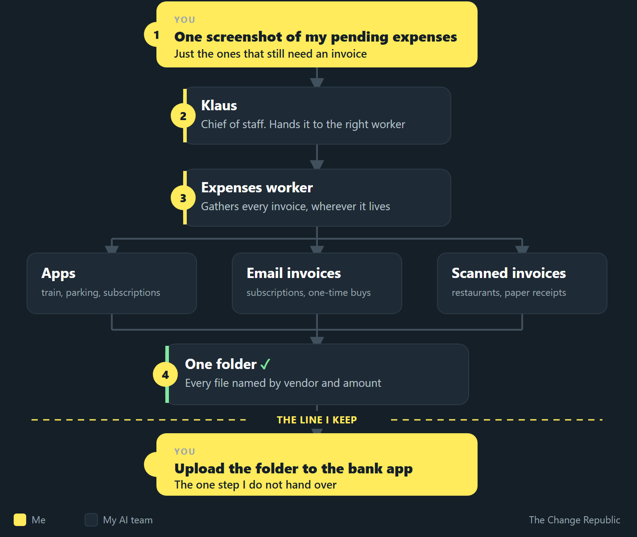
Here is my favourite one, the one that finds all the invoices I
need to attach to my bank account as an entrepreneur.
To build the worker, you will need to use the agentic part of your
AI tool, such as Codex for ChatGPT or Claude Code and they are
included in the ca 20 USD per month subscription. There is plenty
of tutorials on YouTube, how to get started - if you are lost, hit
reply and I will point you to the right direction.
I am genuinely curious what you are all building.
One reader told me after that piece that he liked what I had built,
but had no idea where to begin. So he copied the whole newsletter
into Claude and asked it to build him something similar, around his
own setup. That is also a great way to start, if all of this still
feels confusing.
The Coach I Built on Three Dog Walks
Since we are talking about building. I recently rebuilt my AI
coach. On dog walks.

Coach Tünde is the
AI version of my coaching practice. I wanted it to have a new look
and a better feel. The old me would have written "find a developer"
on a list and carried that list around for three months.
Instead, this happened. Evening walk. Phone in one hand, leash in
the other. I told Klaus, my AI chief of staff, what I wanted. He
wrote the full brief, pages of it. I dropped the brief into Replit,
a tool that turns plain English into working apps. Replit asked me
a few questions back, in normal words, and I answered them while
the dog inspected every tree twice.
Three dog walks later, the new Coach Tünde was live.
I am a coach and a consultant, not an engineer. Two years ago I
would have laughed at this whole paragraph. And it is exactly what
I keep telling the leaders I work with. The future is not AI
replacing experts. It is experts amplifying what only they can do.
The coach from those dog walks is live, and you can try it. Bring
it a real question on your career, AI or leadership. Choose
Coaching mode for a real (mini) coaching session or ask for advice.
The first questions are free.
One Last Thing: The Real Bridge, Live
On July 29th I am going live on LinkedIn with the amazing Dana
Rollinger. We are calling it The Real Bridge, and the question we
are asking is a simple one: AI and leadership, who is it really
for? Come with your own questions. It is free, and it starts at 5pm
CET / 11am ET.

Before I Go...
Look back at everything here and it is really one idea, repeated. A
worker that finds my invoices. A coach that carries my questions.
Each one started as something I was tired of doing by hand or
repeating many times, and each one freed me for the part no tool
can take: the listening, the judgment, the decision that actually
matters.
That is the whole move. You do not need twenty-three. You need one.
Pick the task that drains you most, and hand it over.
Which job will you hand over first?
|